Near Fort Frances, Ontario

CarbonFree Fort Frances

A ~167 MWAC solar project near Fort Frances, awarded a 20-year contract under the IESO’s Long-Term 2 procurement and designed to keep the land in agricultural production.

Contract awarded April 2026 Operation by May 2030 Developed by CarbonFree since 2006
~167 MWac
Nameplate capacity delivered to the grid
~210 MWdc
Installed panel capacity across the site
20 years
IESO contract term from the operation date
May 2030
Commercial operation on or before 1 May 2030
The project

Project facts

A proposed solar photovoltaic development designed to contribute to the Government of Ontario’s goal of accelerating new electricity generation from renewable sources to support the province’s growing energy needs.

Project name
CarbonFree Fort Frances
Proponent
CarbonFree Fort Frances Ltd.
Technology
Solar photovoltaic
Procurement
IESO LT2(e-1)
Contract awarded April 2026; 20 years from commercial operation
AC capacity
~167 MWac
DC capacity
~210 MWdc
Location
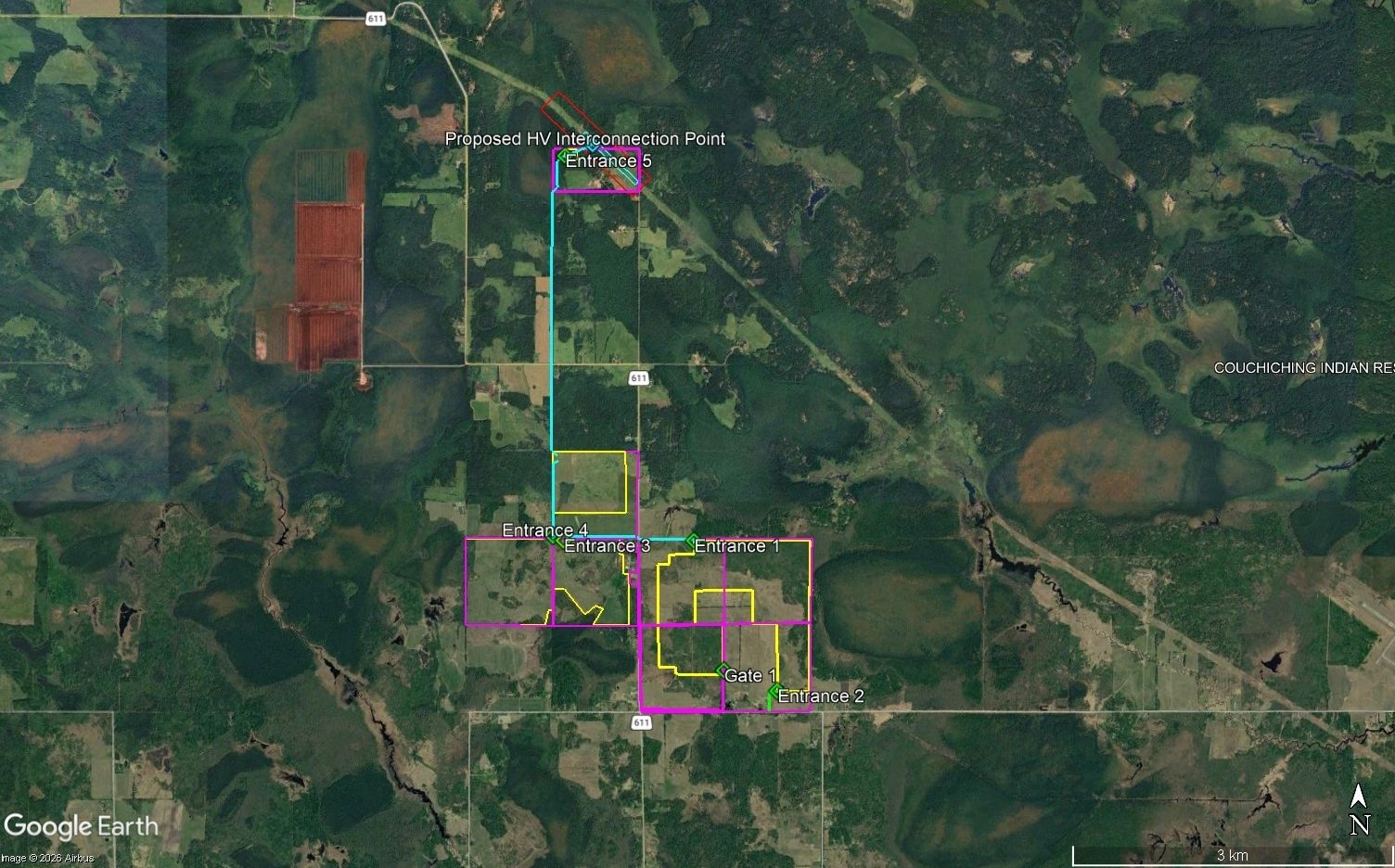
Township of Miscampbell, approximately 10 km northwest of Fort Frances along Highway 611.
Miscampbell Township Ontario
Site map of the CarbonFree Fort Frances project northwest of Fort Frances
Site location

Township of Miscampbell, along Highway 611

Important updates

What’s changed, and when

One entry per milestone, newest first.

Recognition

Recognised by Agrivoltaics Canada

CarbonFree Fort Frances was recognised by Agrivoltaics Canada as “a pioneer in bringing agrivoltaics into the mainstream in Ontario—demonstrating that clean energy development can strengthen, rather than replace, Canadian agriculture.”


Procurement

Contract awarded under IESO LT2(e-1)

CarbonFree Fort Frances has been awarded a contract in the IESO’s Long-Term 2 RFP for energy. Proposals were submitted on 16 October 2025; the project must reach commercial operation on or before 1 May 2030, and the contract runs 20 years from that date.

Agricultural commitment

Agrivoltaics in action

The project embraces agrivoltaics — a land-use model that combines solar energy production with active agricultural practices. The project is committed to returning more land to agricultural production than is taken out: formerly cleared lands go back into production, seeded with grazing species and maintained throughout the project’s operational life.

Livestock grazing

Rotational grazing in partnership with local agricultural producers, with grazing cycles timed to avoid overgrazing. It supports local farming operations and maintains the land naturally, without chemical herbicides.

Pollinator habitat

Native wildflower meadows planted to support bees and other pollinators vital to the surrounding agricultural ecosystem — goldenrod, black-eyed Susan and wild bergamot.

Community apiary

The project is exploring a community-led shared apiary initiative, to support the broader agricultural lands and the growth of local farm products.

Livestock grazing

Grazing under the panels

Rotational grazing in partnership with local agricultural producers supports native pasture and maintains vegetation naturally, without chemical herbicides.

Why solar

How solar PV supports a greener Ontario

Solar photovoltaic (PV) technology transforms sunlight into electricity using specially designed panels made of semiconductor materials.

  • Clean and renewable. PV systems generate electricity with zero greenhouse gas emissions.
  • Quiet and low impact. Solar panels operate silently and have a minimal footprint on surrounding communities.
  • Reversible land use. PV installations are designed to be temporary, preserving the land’s long-term value.
  • Energy security. Solar projects help diversify Ontario’s energy mix and enhance resilience.
  • Long-term stewardship. Solar projects can coexist with natural ecosystems and even improve site conditions over time.
Community & Indigenous engagement

Open houses & meetings

Engagement has been ongoing since March 2025. We host open houses to gather input and answer questions, and post the dates here as they are confirmed.

Open house

Couchiching First Nation Open House

Community members were invited to learn about the proposed solar project.

Webinar

Agrivoltaics Canada webinar

Public meeting

Second Public Meeting

A follow-up to the first public meeting in September 2025, giving the community an opportunity for input.

Fair

Emo Agricultural Fair

Project documents

Everything on the public record

Current versions. Superseded ones move to the Historical band below rather than being deleted.

Meeting notice

Second Public Meeting Notice

Historical

Superseded versions

Kept on the page so the record of what was filed, and when, stays intact.

Economic benefits

Work and business for the region

The project will generate substantial employment and local contracting during construction, with several long-term roles in site maintenance, vegetation management, and system monitoring and inspection.

Employment

Substantial employment and local contracting during construction, and long-term contract roles once the project is operating.

Local contractors first

Priority for civil works (fencing, earthworks, road construction), vegetation and local road improvements, and catering and accommodation during construction.

Indigenous participation

A commitment to Indigenous participation through equity partnerships, training and procurement opportunities.

Who we work with

Local partnered contractors

George Armstrong Co. Limited
Local partnered contractor
Landmark Survey and Testing
Local partnered contractor
TBT Engineering Consulting Group
Local partnered contractor
Contact the project

Ask us anything about Fort Frances

Messages sent from this page go to the Fort Frances project team.

Goes to fortfrancessolar@carbonfree.com · We reply within two business days